
 By Emma Dylan
Suspension components rarely fail with the dramatic finality of a snapped serpentine belt or a dead alternator. Instead, they deteriorate across thousands of miles of subtle wear, bleeding away their hydraulic damping capacity so gradually that your brain naturally compensates for the degradation. You subconsciously anticipate extra body roll through highway off-ramps, brace for harsh impacts over familiar potholes, and get used to a slightly looser steering feel, writing it off as the normal personality of an aging vehicle.
Because suspension wear happens so slowly, drivers are uniquely vulnerable at the repair shop counter. A service advisor might recommend spending thousands on brand-new assemblies based strictly on an arbitrary milestone like fifty thousand miles, while on the other end of the spectrum, an inattentive driver might pilot a dangerously unstable chassis until a ball joint fails or a tire tears itself apart. Determining whether your shocks or struts genuinely need replacement requires moving past generic mileage intervals and learning how to interpret physical handling symptoms, tire wear patterns, and mechanical hardware condition.
The Structural Difference: Shocks Versus Struts
Before diagnosing your vehicle, you need to understand what components are actually installed on your axles. While drivers often use the terms interchangeably, shocks and struts are fundamentally different mechanical components that perform distinct engineering jobs.
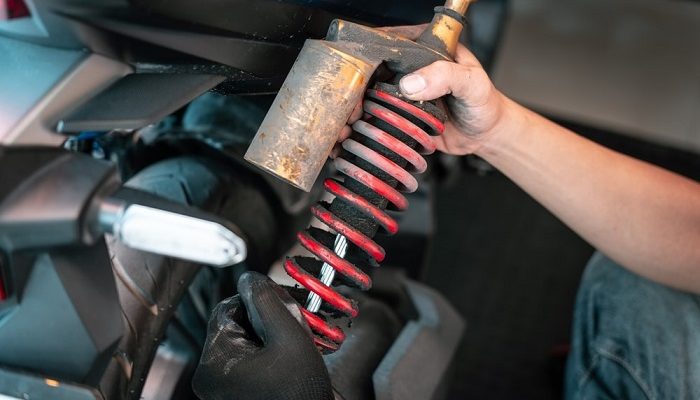
A shock absorber—properly called a damper—is a standalone hydraulic or gas-charged piston mounted alongside a coil spring or leaf spring. Its sole responsibility is to control the rebound and compression energy of the spring. It does not carry the weight of the vehicle, nor does it maintain wheel alignment. If you unbolted a shock absorber entirely, the car would still sit at its normal ride height, though it would bounce uncontrollably like a pogo stick over every ripple in the asphalt.
A strut, on the other hand, is a structural load-bearing member of the suspension system. A MacPherson strut assembly combines the spring, the hydraulic damper, and the steering pivot into a single unit. It physically holds up the chassis, maintains wheel camber and caster angles, and bears side-load forces during cornering. Replacing a worn strut requires specialized spring compressors and an immediate four-wheel alignment, making it a substantially more involved and costly service than swapping out an independent shock.
Dynamic Handling Symptoms You Can Feel Behind the Wheel
The most reliable indicator of compromised damping is how your car behaves when dynamic weight shifts occur. When you drive, accelerate, turn, and brake, energy constantly transfers across the four corners of the chassis. Healthy dampers absorb this energy instantly; worn units let the springs oscillate freely.
Nose-Diving and Rear-End Squatting
Pay close attention to what happens when you press firmly on the brake pedal. If the front bumper pitches violently downward—a phenomenon known as nose-diving—the front dampers can no longer counteract the forward inertia of the vehicle. This is not merely an aesthetic annoyance; it severely unweights the rear tires, increases stopping distance by several car lengths in an emergency, and causes the anti-lock braking system to cycle prematurely. Similarly, if the rear end dips toward the asphalt when you accelerate hard from a dead stop, the rear dampers are failing to control the backward momentum of the sprung mass.
Excessive Body Roll and Sway
When navigating a curving interstate on-ramp or executing a sharp lane change, the vehicle should lean into the turn progressively, set on its suspension, and stay composed. If the body leans excessively to the outside of the turn, feels sloppy, or requires continuous steering corrections to track a clean arc, the dampers are no longer keeping the vehicle’s center of gravity anchored. High-profile vehicles like SUVs and crossover utility vehicles become noticeably susceptible to crosswinds when their damping degrades, wandering unpredictably on open highways.
Unsettled Rebound and Bottoming Out
When your tire strikes a speed bump or a dip in the pavement, the suspension should compress, rebound, and settle back to baseline almost immediately. If the vehicle cycles through two or three vertical bounces before regaining its composure, the internal hydraulic valves have degraded. If you hear a loud, metallic clunk or feel a jarring jolt through the floorboards over moderate bumps, the suspension has run out of travel and hit the rubber bump stops, signaling that the strut or shock is no longer offering hydraulic resistance against sudden compression.
Visual and Physical Diagnostics in the Driveway
Road feel provides the primary clue, but you should always confirm your suspicions with a physical inspection before committing to a costly repair.
Differentiating Normal Weeping from Blown Seals
Get down on the ground with a flashlight and inspect the smooth, cylindrical body of each damper. Every shock and strut contains internal hydraulic oil under pressure. Over tens of thousands of cycles, a minute amount of oil naturally bypasses the piston seal to lubricate the shaft. This creates a light, dry film of oil that attracts fine road dust—a cosmetic condition automotive engineers call weeping. Weeping is harmless and does not warrant replacement.
A true failure presents as a wet, shiny, active coating of dark oil covering the damper body, often running down the sides and dripping onto suspension arms or the lower spring perch. If you wipe your finger across the unit and pick up liquid hydraulic oil, the main seal has ruptured. Once the fluid leaks out, internal gas pressure drops, cavitation occurs, and the damper loses its ability to control movement.
Cupping and Scalloped Tire Tread
Tires offer an accurate visual diary of suspension health. Run your bare palm along the perimeter of the tread face on both edges. If you feel high and low scalloped dips resembling small scoops carved out of the rubber every few inches, you are feeling tire cupping. When a shock or strut is worn out, the tire actually micro-bounces down the road at highway speeds rather than staying glued to the pavement. Every time the rubber slams back down onto the road surface, friction shears away a patch of tread. Severe cupping generates an audible, rhythmic roaring noise inside the cabin that many drivers incorrectly mistake for a failing wheel bearing.
The Limits of the Traditional Bounce Test
The classic backyard diagnostic involves standing on the bumper, vigorously bouncing a corner of the car, jumping off, and watching how quickly it stops. On older American sedans and trucks with soft, long-travel springs, this test worked well. On modern vehicles with stiff, progressive-rate springs and multi-link suspensions, the bounce test is frequently misleading. Modern springs are often so firm that a human cannot compress them hard enough to reveal worn damping valves. Passing a driveway bounce test does not necessarily mean your modern suspension is roadworthy.
Moving Past Arbitrary Mileage Recommendations
The automotive service industry often pushes shock and strut replacements at rigid intervals like fifty thousand or sixty thousand miles. While dampers do wear out, their actual lifespan is entirely dictated by operating environment rather than odometer readings alone.
A vehicle driven primarily on smooth, newly paved sunbelt highways can easily maintain effective damping characteristics well past eighty or one hundred thousand miles. Conversely, a vehicle driven daily across salted, frost-heaved northeastern city streets, unpaved washboard rural roads, or used regularly for heavy towing can compromise its internal valving in half that time.
Do not replace shocks and struts simply because an arbitrary number on your dashboard appears. Replace them when you see active liquid fluid coating the body, observe scalloped wear across your tire tread, or notice that your vehicle takes longer to settle after bumps, dives under braking, and leans through corners. Prioritizing these genuine physical markers ensures you protect your tire investment, maintain emergency stopping performance, and keep your hard-earned money out of unnecessary repair shop invoices.
What is your reaction?
Excited
0
Happy
0
In Love
0
Not Sure
0
Silly
0